Wood Fence Styles – A Complete Photo Guide for Homeowners
Wood fence styles fall into three broad categories based on how the boards are arranged: privacy styles that block sightlines completely (shadow box, tongue-and-groove, board-on-board), semi-open styles that provide partial screening (spaced picket, lattice top), and horizontal styles that run boards lengthwise for a contemporary look. The right style for your property depends on how much privacy you need, your home’s architecture, and your budget. Below are seven styles Super Fence Co. builds regularly, shown with real completed projects rather than stock photography.
Wood Fence Styles at a Glance
Use this table to compare all seven styles before reading the full breakdown of each:
| Style | Privacy Level | Best Use | Best For |
| Shadow Box | Semi-full | Shared property lines | Good-neighbor fencing |
| Tongue-and-Groove | Full | Maximum privacy | Backyards, pool areas |
| WRC Spaced Picket | Open | Front yards, curb appeal | Traditional homes |
| WRC Horizontal Board | Full or semi | Modern, architectural look | Contemporary homes |
| Lattice Top | Full base, open top | Style upgrade on privacy fence | Climbing plants, added height |
| Arc Spaced Picket | Open | Decorative front boundary | Traditional and cottage homes |
| Post-and-Board | None | Property line definition | Rural and open-lot properties |
Shadow Box Fence
A shadow box fence alternates pickets on both sides of the rail, so the fence looks identical from either side – no ‘good side’ and ‘bad side.’ This makes it the standard choice for shared property boundaries. It provides near-full privacy from a direct viewing angle, with a slight gap allowing airflow and partial oblique views.
Best use: shared property lines, backyard privacy where both neighbours want a finished-looking fence. For the full breakdown of styles, upgrades, and specifications, see our dedicated shadow box fence page.
Tongue-and-Groove Fence
Tongue-and-groove boards interlock like puzzle pieces, with no gaps between boards even as the wood expands and contracts seasonally. This is the premium full-privacy option – structurally rigid, completely private, and often specified where pool codes require zero visible gaps.
Best use: maximum privacy, pool enclosures, properties needing a code-compliant zero-gap barrier.
WRC Spaced Picket Fence
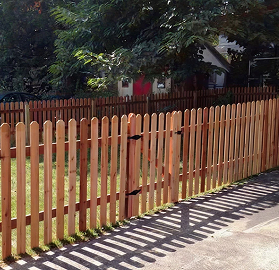
A classic picket fence built in Western Red Cedar, with vertical boards spaced 1 to 3 inches apart. Open and decorative rather than private, this is the style most associated with traditional American front yards, and it pairs naturally with colonial and cottage-style homes across the Main Line.
Best use: front yards, garden borders, decorative boundaries where privacy is not the goal.
WRC Horizontal Board Fence
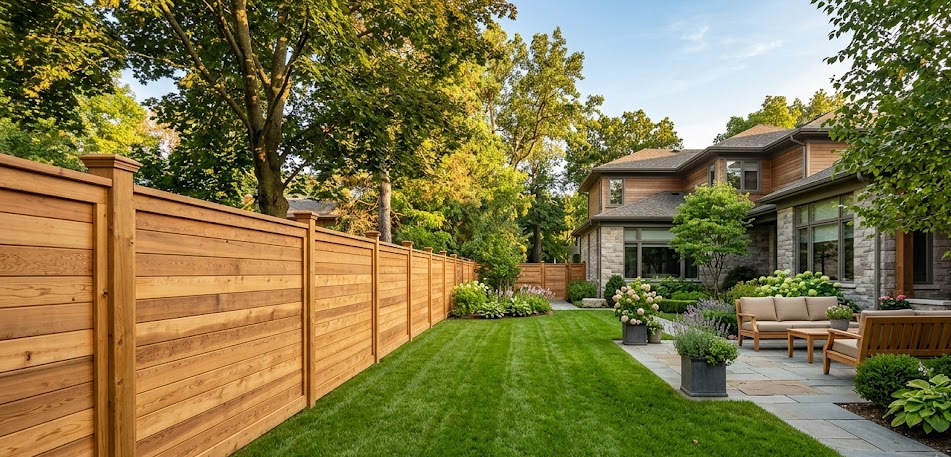
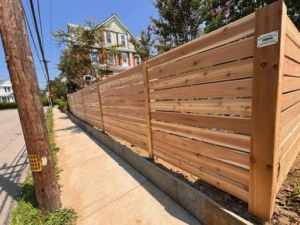
Boards run lengthwise instead of vertically, creating clean, contemporary lines that suit modern builds and reinforce the horizontal architecture common in stone colonials and brick homes alike. Available in tight-privacy spacing or a more open, decorative gap.
Best use: contemporary homes, side yards where a fence needs to feel wider, properties wanting a modern design statement. For a full breakdown of spacing options, Western Red Cedar vs Eastern White Cedar, and the installation process, see our dedicated horizontal cedar fence page.
Lattice Top Fence
A lattice top fence combines a solid privacy base – typically shadow box or tongue-and-groove – with a decorative criss-cross lattice section along the top few inches to a foot. This adds height and visual interest without fully closing off the top of the fence, and it doubles as a support structure for climbing vines.
Best use: adding height to an existing privacy style, gardens with climbing plants, softening a tall privacy fence’s appearance.
Arc Spaced Picket Fence
A variation on the spaced picket style where the top rail curves in a gentle arc between posts, rather than running flat. This is a purely decorative upgrade that adds a distinctive, softened silhouette to an otherwise simple open picket fence, popular for front yards and garden entrances.
Best use: decorative front boundaries, garden entrances, cottage and traditional home styles.
Post-and-Board Fence
The simplest and most affordable wood fence style: horizontal boards or rails attached directly to posts with open gaps between rails, offering property line definition without privacy or full containment. Similar in spirit to split rail fencing, but built with flat board rails rather than round rails.
Best use: rural and open-lot properties, marking a boundary without blocking the view, budget-conscious projects.
Real Photos, Real Local Projects
Every photo in this guide is a completed Super Fence Co. installation – not stock photography or a manufacturer’s catalogue image. We think this matters: a fence style can look very different in a Southern California backyard than it does against a Main Line stone colonial or a Delaware County split-level. Seeing the actual style built with the actual materials, in the actual light and landscaping of this region, gives a far more accurate sense of what to expect on your own property than a generic product photo.
Choosing a Style for Your Main Line Home
Main Line properties span a wide range of architecture, and the right wood fence style should complement it. Stone colonials in Bryn Mawr and Gladwyne suit shadow box or tongue-and-groove in a natural or warm stain, echoing the material warmth of the stone. Contemporary builds pair naturally with horizontal board styles. Craftsman and cottage homes around Ardmore and Media often suit picket or arc spaced picket styles at the front, with a more private shadow box or lattice-top style at the rear. Township and HOA rules across Delaware County, Montgomery County, and Chester County frequently specify maximum front-yard fence height and, in some communities, restrict fully solid front-yard fencing – our estimators confirm your specific township’s requirements at every free on-site visit.
Frequently Asked Questions
What is the most popular wood fence style?
Shadow box is the most requested wood fence style on the Main Line, largely because it looks identical from both sides and is the standard choice for shared property boundaries. Horizontal board styles have grown quickly in popularity among homeowners wanting a more contemporary look.
What is the cheapest wood fence style?
Post-and-board fencing is the most affordable wood fence style, since it uses the least material and has no privacy boards to mill and hang. Spaced picket styles are the next most affordable open option.
Which wood fence style offers the most privacy?
Tongue-and-groove offers the most complete privacy, since the interlocking boards leave no visible gap even as the wood expands and contracts seasonally. Shadow box is a close second, offering near-full privacy from a direct angle while allowing airflow through its alternating picket design.
What is the difference between shadow box and board-on-board fencing?
Shadow box alternates pickets on both sides of a single rail, so both faces look identical. Board-on-board overlaps pickets on one side only, giving maximum privacy from that side but a slightly less finished appearance on the reverse. Shadow box is generally preferred for shared boundaries; board-on-board for full privacy where only one side matters.
Can you add a lattice top to an existing wood fence?
In many cases, yes, if the existing fence’s posts and rails are in good structural condition. A lattice top section can often be added along the top of a shadow box, tongue-and-groove, or board-on-board fence to increase height and add a decorative element. Super Fence Co. can assess your existing fence at a free estimate visit.
How much does a horizontal wood fence cost compared to a traditional style?
Horizontal wood fencing typically costs 20 to 35 percent more than a comparable traditional vertical style. The premium reflects more careful lumber selection and more labour-intensive, board-by-board installation.
What wood fence style is best for a front yard?
Spaced picket and arc spaced picket are the most popular front-yard styles, since they define the property line and add curb appeal without fully enclosing the yard – and many townships restrict solid fencing in front yards regardless of style. For rear and side yards where privacy matters more, shadow box or tongue-and-groove are typically better suited.
Ready to Choose Your Wood Fence Style?
Super Fence Co. has been building custom wood fences for Main Line homeowners since 2002, with an on-premises cedar woodworking shop that lets us build any style shown in this guide – and non-standard designs beyond it. Call (610) 642-4450 or request a free fence estimate today.