
How to Keep Dogs from Digging Under Your Fence
Dogs dig under fences to escape, cool off, relieve stress, or simply because the ground on the other side smells more interesting. The most reliable fix combines a physical barrier at ground level – buried hardware cloth, an L-footer, or a concrete curb – with a fence type that does not give a determined dog an easy edge to start from. A quick fix rarely holds; the barrier has to go where the dog actually digs, not just along the whole fence line in general.
Why Dogs Dig Under Fences
Before choosing a fix, it helps to know which of these is driving your dog’s digging, because the right barrier is the same either way but the long-term solution is not:
- Escape to play – your dog has spotted something worth investigating: another dog, a walking path, a neighbour’s yard, wildlife.
- Separation stress – digging often starts right when you leave the house, and may be paired with barking, whining, or scratching at doors.
- Cooling off – shallow pits in shaded or damp soil are a classic sign of a dog trying to reach cooler ground in hot weather.
- Boredom or excess energy – a dog left alone in a yard for long stretches without enrichment will often dig simply because there is nothing else to do.
- Prey drive or curiosity – some dogs dig at specific spots because they can smell or hear something underground, such as a burrowing animal.
A barrier stops the escape regardless of the cause, but pairing it with more exercise, supervised yard time, or a legal digging spot (a sandbox or loose-soil area) addresses the reason the digging started in the first place.
4 Proven Methods to Stop Digging Under a Fence
These are the methods that actually hold up against a determined digger, ranked from most affordable and DIY-friendly to most permanent:
| Method | How It Works | Effort / Cost | Best For |
| Buried Hardware Cloth / Mesh Apron | Bury galvanized wire mesh 12-18 inches deep along the fence line, angled outward (an ‘L’ shape) so the dog hits mesh before it can dig deep enough to pass under | Low-medium cost; moderate DIY effort | Most yards; works with almost any existing fence |
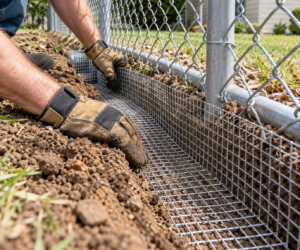
| L-Footer (Wire Extension) | A horizontal wire mesh skirt attached to the base of the fence and staked flat along the ground, extending 12-24 inches into the yard | Low cost; low effort, no trench required | Renters, quick fixes, or fences where digging is new and shallow |
| Concrete Curb or Footing | A poured concrete curb set along the base of the fence line, creating a solid barrier a dog cannot dig through | Higher cost; requires professional installation for a clean result | Persistent, high-drive diggers; permanent solution |
| Fence Extension (for dig-and-climb dogs) | An angled or vertical extension added to the top of an existing fence, for dogs that also try to climb or jump once digging is blocked | Medium cost; straightforward add-on installation | Dogs that switch tactics once the ground-level route is closed |
How to Install a Buried Hardware Cloth Apron
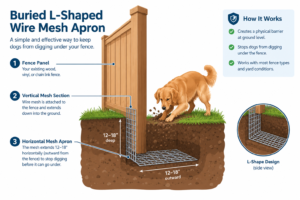
This is the most common DIY fix and works with almost any fence type:
- Watch your dog over a few sessions and mark every spot along the fence where digging has started or is likely, rather than assuming the whole fence line needs treatment.
- Dig a trench roughly 12 inches deep and 12 inches wide directly along the base of the fence at the marked sections.
- Cut galvanized welded wire mesh to the length of the trench, with enough extra to bend an L-shape: one section running vertically against the fence, one running horizontally into the trench floor.
- Secure the vertical section to the fence with zip ties, hog rings, or fasteners appropriate to your fence material.
- Backfill the trench, tamping the soil down firmly over the horizontal mesh section so it sits flush with the yard.
- Check the repaired sections after the first few storms or freeze-thaw cycles, since settling soil can occasionally expose an edge.
A Word of Caution – Skip Electric and Shock Deterrents
Some online advice suggests electric fencing or shock-based deterrents to stop digging. We do not recommend this. A shock deterrent does not address why the dog is digging in the first place – it only adds fear to the situation, and a genuinely motivated digger, particularly one driven by separation stress, can still dig through or around it. A buried physical barrier is a more humane and more reliable fix, because it works regardless of the dog’s motivation and does not rely on a painful correction to be effective.
Best Fence Type for a Dog That Digs
A barrier retrofit works on any fence, but if you are installing new fencing or replacing an aging one, some materials are naturally more dig-resistant than others – and some pair much better with a buried mesh apron than others do.
| Fence Type | Dig Resistance | Notes |
| Chain Link | Best overall – pairs cleanly with a buried mesh apron or tension wire at the base | The most common professional recommendation for dog owners; can add a bottom rail or tension wire for extra rigidity at ground level |
| Vinyl / PVC | Good – solid panels give no gaps to widen, but the smooth bottom edge still needs a buried barrier | Ideal when paired with an L-footer; no rot risk at ground contact |
| Wood (Privacy / Shadow Box) | Moderate – solid panels help, but ground contact boards can rot and create soft, diggable edges over time | Works well with a buried mesh apron and a kickboard or rot board at the base |
| Basic Chain Link (no add-ons) | Weakest without upgrades – open bottom gap is the easiest starting point for a determined digger | Fine for most dogs, but diggers need the apron or tension-wire upgrade |
For most Main Line dog owners, our recommendation is chain link fence installation with a tension wire or buried mesh apron added at the base – it is the most cost-effective option that pairs cleanly with a digging barrier. If privacy matters more than cost, wood fence installation on the Main Line or vinyl fence installation both work well with the same buried-barrier approach.
Digging and the Main Line’s Clay Soil
Soil conditions across the Main Line, Delaware County, Montgomery County, and Chester County tend toward dense clay, which affects both digging and fence installation. Clay-heavy soil holds moisture near the surface after rain, which can actually make it easier for a motivated dog to dig a shallow escape route along a fence base, especially where drainage pools. It also means buried barriers should be set at least 12 inches deep and compacted firmly, since loosely packed clay can settle and gradually expose an edge over a season or two. Seasonal freeze-thaw cycling in Pennsylvania winters can further shift soil near the fence line, so a check after the first winter is worth doing on any newly installed barrier.
Frequently Asked Questions
What stops a dog from digging under a fence the fastest?
An L-footer – a horizontal wire mesh skirt staked flat along the ground at the base of the fence – is the fastest fix because it requires no trenching. It will not last as long as a buried apron or concrete curb, but it can be installed in an afternoon and stops most digging attempts immediately.
How deep does a dig-proof barrier need to be?
A buried hardware cloth apron should go at least 12 inches deep, angled outward in an L-shape for extra resistance. Determined or larger diggers may need 18 inches. In Main Line clay soil, compact the backfill firmly, since loosely packed soil can settle and gradually expose the barrier’s edge over time.
Does chicken wire stop dogs from digging under a fence?
Chicken wire is not strong enough for most dogs – it bends and tears under sustained digging or chewing. Galvanized welded wire mesh (hardware cloth) with a tight grid and heavier gauge wire is the standard, more durable choice for a buried barrier or L-footer.
Is a buried chain link fence enough to stop digging on its own?
Not usually. Standard chain link is set with a small gap at the ground to follow yard grading, which is exactly where a determined dog will target. Adding a tension wire at the base or a buried mesh apron closes that gap and makes chain link one of the most dig-resistant fence types once upgraded.
What is an L-footer?
An L-footer is a wire mesh barrier shaped like the letter L: one section runs vertically against the inside of the fence, and the other runs horizontally along the ground, staked flat. The horizontal section is what actually stops the dig, since the dog hits mesh a few inches down instead of open soil.
Are electric or shock fences safe for stopping digging?
We do not recommend them. Shock-based deterrents add fear without addressing why the dog is digging, and a highly motivated or anxious digger can still push through. A buried physical barrier is a more humane and more consistently effective solution, since it works regardless of the dog’s underlying motivation.
Do dogs stop digging under a fence on their own over time?
Rarely, if the underlying motivation is still present. A dog digging from separation stress, boredom, or a strong interest in what’s on the other side will typically keep trying unless the behaviour is blocked with a barrier and the underlying cause is addressed with more exercise, enrichment, or supervised time.
What is the best fence for a dog that digs?
Chain link with a buried mesh apron or tension wire at the base is generally the best combination of cost and dig resistance. Vinyl and wood privacy fencing also work well paired with a buried barrier, and additionally block the sight lines that often trigger digging in the first place. Super Fence Co. can recommend the right combination for your yard and your dog at a free on-site estimate.
Ready for a Dig-Resistant Fence on the Main Line?
Super Fence Co. has installed fences for pet owners across the Main Line since 2002 – including determined diggers. Whether you need a buried barrier added to an existing fence or a new chain link, wood, or vinyl fence built to keep your dog secure, our team can help. Call (610) 642-4450 or request a free fence estimate today.